
























































Imagine a director of IT operations researching a new security platform. On Monday she reads a comparison article on her work laptop. On Wednesday she listens to a vendor podcast on her phone during the commute. On Friday she downloads a buyer’s guide using her work email, then forwards it to two colleagues who open it from home.
To your marketing stack, that could look like four or five strangers. To her, it was one line of research.
This gap between how buyers actually behave and how marketing systems see them is the reason identity resolution has become such a pressing topic. B2B teams spend heavily to reach the right people, yet their data often splinters each person into fragments spread across devices, browsers, forms and tools. When cookies were the glue holding those fragments together, the cracks were easier to ignore. Now they are hard to miss.
This article walks through why B2B audience identification needs a rethink, how people-based marketing works in practice, and what it takes to build a reliable approach to identity resolution in a cookieless environment.
Why B2B Marketers Need to Rethink Audience Identification
For years, third-party cookies did a lot of the work of recognizing visitors and following them across the web. They were never perfect, and in B2B they were often a poor fit to begin with.
Here is why the old approach struggles:
- Browsers already limit cookies. Safari and Firefox block third-party cookies by default. Google decided to keep them in Chrome, but a large slice of web traffic is already out of reach for cookie-based tracking.
- Consent rules narrow what you can collect. Privacy laws and consent banners mean many visitors decline tracking, which leaves gaps in any cookie-based picture.
- B2B buyers switch devices constantly. Work laptops, personal phones, tablets and home computers each carry their own cookies, so one buyer can look like several.
- Corporate networks blur identity. VPNs, common IP addresses and security software make it harder to tell who is behind a visit.
- Buying is a group decision. A purchase involves a committee of people. Cookies track browsers, not roles, relationships or accounts.
For B2B audience targeting, this adds up to a frustrating pattern. You pay to reach people you have already converted, miss the colleagues who influence the deal and struggle to connect ad exposure to pipeline.
Cookieless advertising already describes how a large part of your audience browses today. The teams that adapt early build a sturdier foundation than those waiting for one more workaround. Treating cookieless advertising as the default, rather than the exception, changes how you plan budgets, choose channels and judge results.
What Is People-Based Marketing?
People-based marketing means planning, targeting and measuring campaigns around real, known people and the accounts they belong to, rather than around anonymous devices or browser IDs.
In a B2B context, that looks like:
- Reaching a specific buying committee at a target account across LinkedIn, display, connected TV and email
- Recognizing the same person whether they visit from a phone or a laptop
- Adjusting messaging based on someone’s role, seniority and stage in the buying process
- Measuring results by account and person, so you can tie campaigns to opportunities and revenue
None of this works without a dependable way to know who is who. That is the job of identity resolution.
What Identity Resolution Means
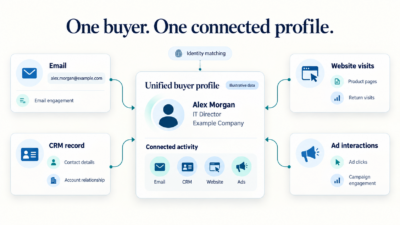
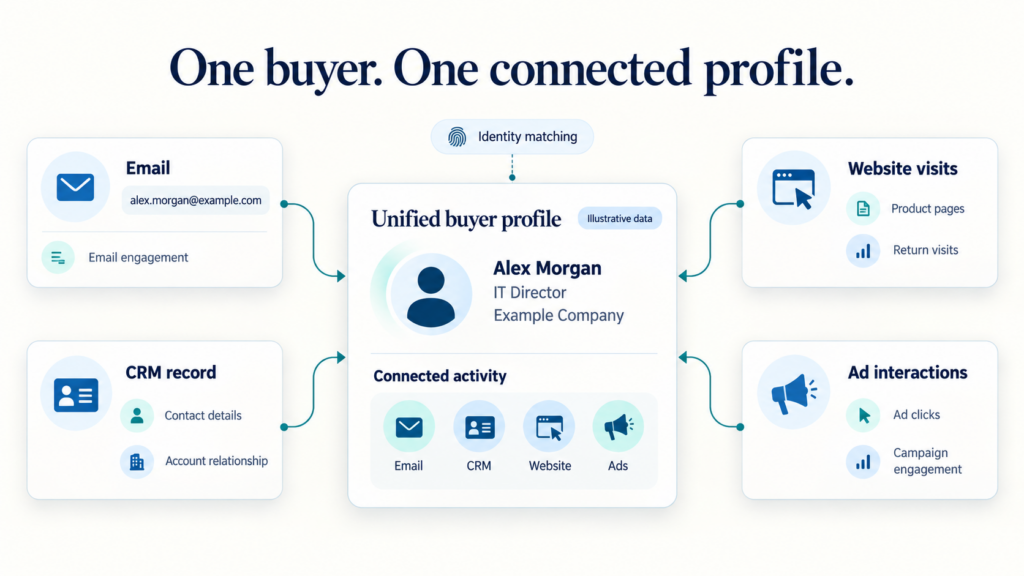
Identity resolution is the process of connecting the scattered data points that belong to one person or one account into a single, accurate record. Those data points might include an email address, a CRM contact, a marketing automation profile, website visits, event registrations, ad interactions and sales conversations.
The output is a set of unified customer profiles: one view of each person, linked to their company, that every team and tool can draw from. Instead of a webinar platform knowing one thing, the CRM knowing another and the ad platform guessing at a third, everyone works from the same picture.
How Identity Resolution Works in B2B Marketing
To understand how identity resolution works in B2B marketing, it helps to break the process into four stages.
Collect. Gather identifiers from every touchpoint you own: form fills, logins, email clicks, event check-ins, chat conversations, product usage and CRM entries.
Match. Compare identifiers to decide which records belong to the same person and which people belong to the same account. This is where cross-channel identity matching happens, linking a hashed email from a newsletter click to a website session and a CRM contact.
Unify. Merge matched records into a single profile, resolve conflicts such as two different job titles, and attach the profile to the correct account hierarchy, including parent companies and subsidiaries.
Activate. Push those profiles and audiences into the channels where you run campaigns and into the systems sales uses every day.
The matching step relies on two methods, and knowing the difference helps you judge any vendor’s claims.
Deterministic matching links records using exact, known identifiers, such as the same email address or login appearing in two places. It is highly accurate but depends on people identifying themselves.
Probabilistic matching uses patterns such as device type, location, IP ranges and behavior to estimate that two records likely belong to the same person. It extends reach but carries more uncertainty.
A simple example helps. If the same work email appears on a webinar registration and a demo request, deterministic matching links them with confidence. If two anonymous sessions come from the same office network at similar times and read similar pages, probabilistic matching might connect them, but you would want more evidence before sending that person a personalized message.
Mature B2B programs use deterministic matching as the anchor and probabilistic matching carefully, with clear confidence thresholds, to fill gaps.
Identity Resolution in a Cookieless Environment
So what changes when you plan for identity resolution in a cookieless environment? The short answer is that the data you own becomes the center of gravity.
Without third-party cookies doing the linking, your dependable connectors are the identifiers buyers hand you directly. Hashed email addresses, logged-in sessions and CRM records become the threads that tie activity together. Ad platforms that rely on authenticated users, such as professional networks, can match your audiences against their own logged-in members, often through privacy-safe clean rooms where neither side exposes raw data.
Server-side tracking, account-level intent data and publisher partnerships built on first-party relationships fill in more of the picture. None of these methods replaces cookies one for one. Together, they create a more durable and more honest view of your audience. Good cross-channel identity matching then connects those pieces, so a buyer who reads your newsletter, attends a webinar and clicks a LinkedIn ad appears as one person in your reports.
Why First-Party Data Marketing Matters So Much
First-party data marketing is the practice of building campaigns on information people have given you directly or generated through their interactions with you. It is the fuel for the whole approach described above.
Your own data has several advantages. It is collected with consent, so it holds up better under privacy rules. It reflects real engagement with your brand rather than guesses from a third party. And because you control it, it does not disappear when a browser changes its policies.
The catch is that many teams collect plenty of first-party data and then leave it sitting in disconnected tools. First-party data activation is the step that turns stored data into action: building audiences from engaged contacts, syncing them to ad platforms, personalizing website experiences and alerting sales when a known buyer returns.
A few ways to strengthen your own data:
- Offer content worth registering for. Research reports, benchmark tools and practical templates earn form fills that buyers do not resent.
- Create reasons to log in. Communities, calculators, customer portals and product trials generate authenticated sessions.
- Keep forms short and progressive. Ask for a little at a time and build profiles over several visits.
- Connect your systems. Make sure marketing automation, CRM, events and product data feed into the same identity layer.
Putting It Into Practice
Moving toward people-based marketing does not require a complete rebuild. A practical path looks like this:
Map your identifiers. List every place you collect data about people and accounts, and note which identifiers each source holds.
Clean the foundation. Deduplicate CRM records, standardize company names and fix account hierarchies before you try to unify anything.
Choose a resolution approach. Decide whether your CDP, CRM, a dedicated identity vendor or a data warehouse will hold the master profile.
Set matching rules. Agree on when records should merge and how much confidence is required for probabilistic links.
Build audiences by role and stage. Use unified customer profiles to group buying committee members by function, seniority and engagement.
Measure at the account level. Track reach, engagement and pipeline influence for each target account instead of relying on click-through rates alone.
Throughout, keep privacy front and center. Be transparent about how you use data, honor consent choices and give people easy ways to opt out. Trust is part of the foundation too.
Seeing Buyers as People Again
B2B buying has always been about people: the analyst building the business case, the manager who needs the problem solved and the executive who signs off. For a while, marketing technology let us treat them as cookies and clicks. The move away from that model is an opportunity to get closer to how buying works.
With solid identity resolution, well-managed first-party data and campaigns built around real buying committees, B2B audience targeting becomes more precise and easier to explain to sales and leadership. The buyer was always one person. Now your systems can see her that way.
Frequently Asked Questions
What is identity resolution in B2B marketing?
Identity resolution in B2B marketing is the process of linking data from different sources, such as emails, CRM records, website visits and ad interactions, into a single profile for each person and connecting that person to the right account. It gives marketing and sales one consistent view of every buyer.
What is people-based marketing?
People-based marketing is an approach that targets, personalizes and measures campaigns around real individuals and their accounts instead of anonymous devices or cookies. In B2B, it means reaching specific buying committee members across channels and tying results back to accounts and revenue.
How does identity resolution work without third-party cookies?
It relies on identifiers that buyers provide directly, such as hashed email addresses, logins and CRM records. These are matched across channels using deterministic rules, supported by carefully applied probabilistic methods, and activated through platforms with logged-in users and privacy-safe clean rooms.
Why is first-party data important for B2B marketers?
Data collected directly from your audience is consent-based, accurate and under your control, so it holds up as browsers and regulations limit tracking. It reflects real engagement with your brand and forms the foundation for identity resolution, audience building and measurement.
What is the difference between deterministic and probabilistic matching?
Deterministic matching links records using exact identifiers, such as the same email address or login, which makes it highly accurate. Probabilistic matching estimates connections from patterns like device, location and behavior, which extends reach but adds uncertainty. Strong programs anchor on deterministic data and use probabilistic matching with clear confidence thresholds.